Oregon Prosperity Council: Springfield Chamber Shares Business Community Voice
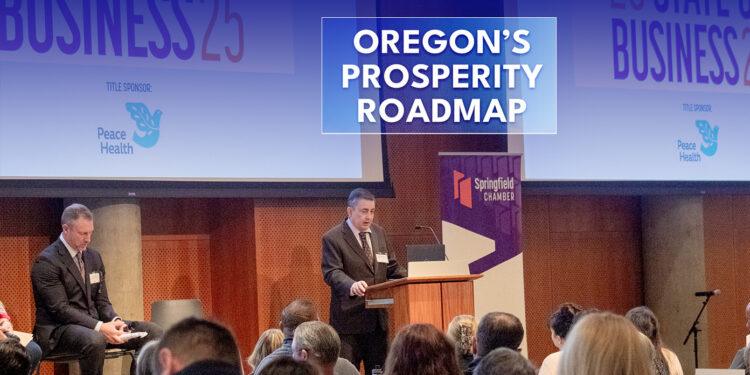
The Springfield Area Chamber of Commerce recently submitted input to Governor Tina Kotek’s Prosperity Council, outlining what they are hearing directly from the business community. The message is as clear as it’s ever been: Oregon’s long-term economic success depends on improving two interconnected areas, our business climate and our workforce pipeline.
The Chamber’s responses to the Prosperity Council’s survey reflect what they hear every day from local employers and community partners. Through their annual Business Climate Survey, Roundtable discussions, direct member engagement, and ongoing work in economic development and workforce initiatives, the Chamber has built a uniquely clear picture of the opportunities and barriers facing businesses in our region.
FOCUS AREA I: IMPROVE THE BUSINESS CLIMATE
“The challenge isn’t one policy, it’s the cumulative weight of many. Without a clear framework to measure impact, businesses are left navigating uncertainty that directly affects their ability to invest and grow.”
– Vonnie Mikkelsen, President & CEO, Springfield Area Chamber of Commerce
What challenge needs to be addressed?
Oregon’s business climate is being shaped by the cumulative impact of taxes, regulations, and permitting challenges. Employers consistently point to:
- Layered taxes and fees across multiple levels of government
- Complex and inconsistent regulatory systems
- Delays and unpredictability in permitting
At its core, the challenge lies not in one policy, but the lack of a system to evaluate how policies work together and impact competitiveness. The Chamber’s annual Business Climate Survey mirrors these concerns, with members identifying public safety, tax structure, regulation, and permitting as top priorities.
What solutions are recommended?
The Chamber is calling for a shift from incremental policy changes to a more coordinated, outcomes-driven approach:
- Pause new taxes and major regulatory mandates
- Review and streamline existing regulations and permitting processes
- Evaluate the cumulative impact of taxes and fees
- Establish a statewide competitiveness framework
Taken together, these recommendations call for a comprehensive “fix-it” framework that moves beyond adding new policies and instead evaluates how existing systems work in practice. This includes reviewing and streamlining regulations and permitting to improve speed and predictability, assessing the combined impact of taxes and mandates, and ensuring alignment across state agencies on economic priorities.
Central to this approach is the creation of a statewide competitiveness framework, with regular benchmarking, clear performance metrics, and a commitment to balancing new requirements with reductions elsewhere. The goal is a more disciplined, outcomes-driven system where policies are measured not just by intent, but by their real-world impact on business growth and Oregon’s overall competitiveness.
What would success look like?
In the next two to three years, success would be found in stability. That is, faster and more consistent permitting across agencies, clear alignment between economic development goals and tax and regulatory policy, and implementation of a statewide competitiveness framework with transparent benchmarking and reporting. Success would also be reflected in improved business sentiment, increased investment and job growth, fewer conflicting or duplicative policies, and a renewed confidence among employers that Oregon is a place where they can invest, grow, and compete.
Who needs to act?
Leadership from the Governor’s Office is critical, particularly through a dedicated role focused on aligning economic policy, coordinating agencies, and ensuring accountability.
FOCUS AREA II: WORKFORCE DEVELOPMENT
“We are asking employers to compete for talent in a system that isn’t fully aligned to deliver it. Until education, workforce, and economic strategies are connected, this challenge will persist.”
– Paige Walters, Senior Director, Advocacy & Economic Development, Springfield Area Chamber of Commerce
What challenge needs to be addressed?
Workforce availability and retention remain among the most pressing issues for employers in our region. While inflation has recently intensified concerns, talent continues to be a long-term constraint. This challenge is closely tied to Oregon’s broader competitiveness, including cost of living and the cost of doing business.
What are the biggest barriers?
Employers point to several systemic issues:
- Gaps in foundational and soft skills
- Limited and complex apprenticeship pathways
- Decentralized education decision-making, which creates inconsistency and inefficiency in delivering workforce-relevant outcomes at scale
- High costs limiting wage competitiveness
- Lack of coordinated data to guide decision-making
To address these challenges, the Chamber is advocating for a more coordinated, system-wide approach that better aligns education, workforce, and economic development strategies. This includes establishing clear accountability for employability and soft skills development, expanding and streamlining apprenticeship pathways, and ensuring workforce investments are closely tied to the needs of high-demand industries.
It also calls for the development of robust, statewide data systems to track outcomes from education to employment, alongside continued support for employer-led training and upskilling initiatives. Success would be reflected in a more workforce-ready talent pipeline, particularly in foundational skills, improved retention of local graduates, and stronger alignment between education investments and real-world workforce needs, guided by reliable, data-driven decision-making.
What should continue?
Programs that are working well include:
- Community college CTE and certificate programs remain among the most effective tools for connecting students to in-demand careers and supporting regional workforce needs. To maximize their impact, Oregon should better align funding with outcomes, recognizing short-term credentials and industry-aligned training as successful pathways, while ensuring colleges have the resources to scale these high-impact programs and maintain strong employer engagement in curriculum development.
- Work-based learning programs (WBLs) continue to play a critical role in connecting students with employers and real-world experience. Continued investment, along with stronger coordination and regional alignment, will be key to scaling these efforts effectively, reducing duplication, and building sustainable partnerships across schools, colleges, and workforce partners.
Who needs to act?
Progress will require coordination across:
- State leadership and policymakers
- Education and workforce systems
- Employers and community partners
Best practices/promising models
Models from other states reinforce what we are hearing locally. North Carolina’s Research Triangle demonstrates how long-term alignment between public-private partnerships, higher education, and economic strategy can drive innovation and growth. That same approach is informing the Southern Willamette Valley Innovation Corridor, where coordinated regional collaboration, supported by strong state leadership, is advancing talent, investment, and innovation. Additional models, such as Massachusetts’ Education-to-Career data systems and streamlined apprenticeship frameworks in other states, highlight the value of aligning education, workforce, and economic development efforts around clear outcomes, particularly in high-wage, high-demand industries.
The Chamber’s message to the Governor’s Prosperity Council is clear: business climate and workforce challenges cannot be solved in isolation. Oregon’s competitiveness depends on aligning policy, education, and economic strategy in a coordinated, outcomes-driven way. The Chamber will continue to elevate the voice of their members and advocate for practical solutions that strengthen the regional economy.
A comprehensive report from the Prosperity Council is expected later this summer.
Have thoughts on these issues? The Chamber wants to hear your perspective, as your input continues to shape our advocacy at the state and local level. Visit the Chamber’s monthly Roundtables, give feedback in a Chamber survey, and follow along on the Business Advocacy page of their website.
Discover more from Springfield Bottom Line
Subscribe to get the latest posts sent to your email.