Chambers Share Business Perspective During Affordability Roundtable with Sen. Merkley
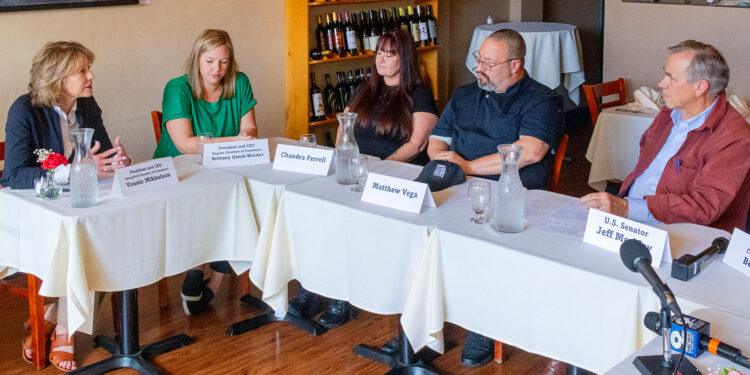
Last Friday, Springfield Area Chamber of Commerce President & CEO Vonnie Mikkelsen was invited to join U.S. Senator Jeff Merkley for a roundtable discussion focused on affordability and economic pressures facing Oregon families and businesses. Eugene Area Chamber President & CEO Brittany Quick-Warner and several representatives from the food, agriculture, health care, and retail sectors were also in attendance. The discussion took place at Cafe Soriah in Eugene.
During the conversation, Mikkelsen emphasized that affordability isn’t just a household budget issue; it has become a workforce and small business sustainability issue. Drawing from preliminary findings from the Springfield Chamber’s 2026 Business Climate Survey, Mikkelsen noted that one in four businesses surveyed identified hiring and retaining employees as a top challenge. Among those employers, nearly two-thirds cited cost of living as a primary factor.
“Our members continue to tell us that affordability pressures are affecting both employers and employees,” Mikkelsen told Sen. Merkley. “Workers need wages that keep pace with housing, food, transportation, and child care costs, while employers are simultaneously facing rising costs for supplies, insurance, utilities, taxes, compliance, and labor.”
Mikkelsen emphasized that affordability pressures facing small businesses have been building over several years, shaped by market conditions, state and local policy impacts, and continued uncertainty. Her message was that the challenge is cumulative, not the result of any single administration, policy decision, or moment in time, and that those pressures are now affecting hiring, pricing, investment, and long-term business stability. She also noted that while food and beverage businesses often feel affordability pressures first because of their thin margins, similar concerns are emerging across industries, including healthcare, construction, manufacturing, and professional services.
“Small businesses cannot simply pass every cost increase on to customers. At some point, they absorb it, delay investment, reduce hours, or start questioning how long they can keep operating that way.”
– Vonnie Mikkelsen, President & CEO, Springfield Area Chamber of Commerce
The Chamber’s message: affordability solutions must address the challenges of housing, workforce availability, taxes, regulation, and the overall cost of doing business – and all of these are interconnected. The policy takeaway is that affordability cannot be solved by looking at wages, prices, or housing in isolation. Policies are needed that reduce the underlying cost pressures on households and small businesses at the same time.
“What small businesses need most right now is greater predictability and relief from compounding cost pressures,” Mikkelsen said. “That allows them to plan responsibly, keep people employed, maintain competitive wages, and continue serving their communities.”
The Springfield Area Chamber appreciates opportunities to bring the voice of local businesses to policy discussions and will continue advocating for solutions that support a strong and sustainable regional economy.
Business climate feedback
Are you a business owner, manager, or employee with decision-making responsibilities? The Springfield Chamber would like to hear from you. Your answers will help shape the Chamber’s advocacy efforts. Have your say: complete the Business Climate Survey today.
More About the Springfield Chamber’s Business Advocacy Efforts
As a trusted convener and provider of business resources, the Springfield Chamber is committed to fostering policies and incentives that contribute to our competitive position in private sector job creation, retention, and economic growth. The Chamber recognizes the systemic interdependencies of a healthy economy and provides an ear and a voice for local business at the confluence of government, commerce, and community. Through a robust platform of member advocacy services, the Chamber advocates for business by increasing visibility, dialogue, and representation at local, state, and federal policy circles around issues of impact and interest to their members.
Discover more from Springfield Bottom Line
Subscribe to get the latest posts sent to your email.