Governor’s Prosperity Council Report Echoes Local Business Voices

When Governor Tina Kotek convened the Oregon Prosperity Council in January, the mission was straightforward: examine why Oregon is falling behind economically and recommend strategies to strengthen the state’s long-term competitiveness.
After months of listening sessions, research, and engagement with business, labor, education, and community leaders across Oregon, the Council delivered a comprehensive report – Recommendations for Oregon’s Long-Term Competitiveness & Prosperity – containing recommendations aimed at improving Oregon’s business climate, workforce, permitting systems, tax structure, and economic development strategy.
For Springfield Area Chamber of Commerce members, the report’s conclusions should sound familiar.
Through the Chamber’s annual Business Climate Survey and conversations with employers throughout the year, businesses have consistently identified many of the same challenges highlighted by the Council: workforce shortages, housing affordability, regulatory complexity, infrastructure needs, and the rising cost of doing business. Those themes were also front and center during the Chamber’s 2026 State of Business program, where Oregon Business Council President John Tapogna and Governor Kotek’s Chief Prosperity Officer Tim Knopp described many of the same competitiveness challenges now reflected in the Council’s recommendations.
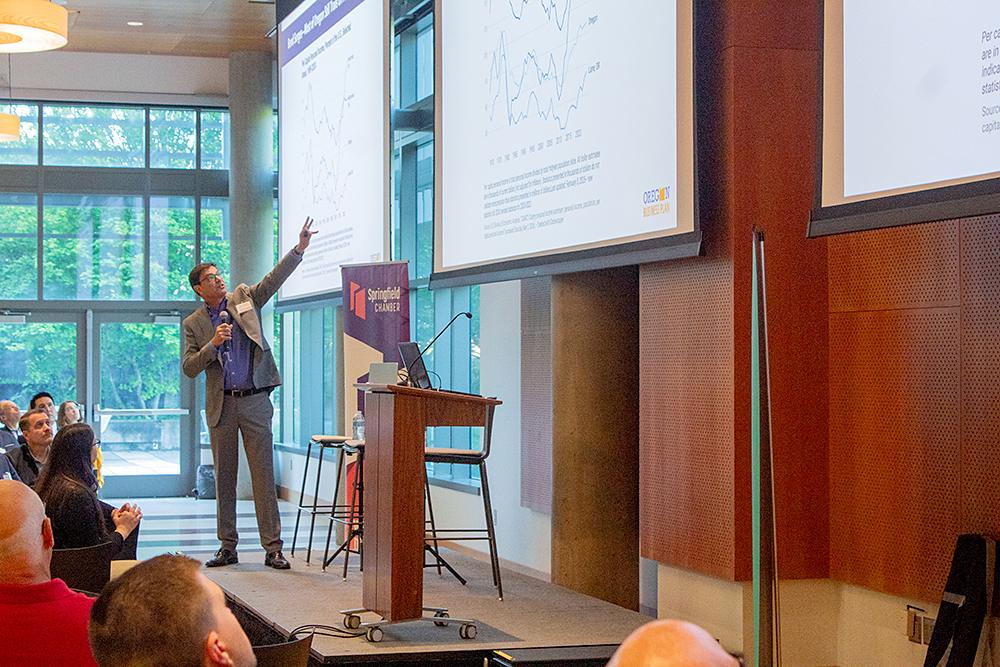
Oregon Business Council President John Tapogna dives into the data at the Chamber’s 2026 State of Business program at Ford Alumni Center in late May.
The Chamber views the report as an important acknowledgment that Oregon’s economic challenges are structural, not temporary; and while the Chamber has not adopted the Council’s individual recommendations as its own policy platform, many of the report’s objectives – including more predictable permitting, improved site readiness, stronger workforce development, modernized economic development tools, and a more competitive environment for business investment – align closely with the Chamber’s long-standing advocacy priorities.
What the Prosperity Council Recommends: 10 Priority Proposals from
Recommendations for Oregon’s Long-Term Competitiveness & Prosperity
Transform Business Oregon into the Oregon Commerce Authority
Create a stronger, business-led statewide economic development organization focused on competitiveness, innovation, and investment.
Modernize Oregon’s tax system to improve competitiveness
Advance near-term reforms, including: modernizing the R&D tax credit; updating the estate tax for family-owned businesses; reducing administrative burdens of the Corporate Activity Tax (CAT); and reconnecting Qualified Small Business Stock (QSBS) to federal law
Develop a long-term tax reform strategy
Convene a bipartisan, stakeholder-led working group to recommend broader tax reforms by 2029.
Establish permitting “shot clocks”
Require agencies to approve or deny complete permit applications within clear statutory timelines while maintaining environmental and public safety standards.
Reduce regulatory burdens by 20% by 2029
Eliminate outdated and duplicative regulations to improve efficiency while preserving essential protections.
Replace the Climate Protection Program with Cap and Invest
Adopt a market-based greenhouse gas reduction program aligned with California and Washington while maintaining labor standards for public investments.
Invest $250 million per biennium in site readiness
Create a recurring fund to prepare industrial and employment lands with the infrastructure needed to attract business investment and housing.
Modernize industrial land policies
Update statutes and standards to ensure Oregon has an adequate supply of development-ready sites for target industries.
Better align economic and workforce development
Create a Governor’s Cabinet of Economic & Talent Development and implement a statewide Talent Alignment Strategy with measurable outcomes.
Strengthen higher education’s role in economic growth
Increase strategic investment in higher education and research partnerships, including $20 million per biennium for the University Innovation Research Fund.
At the same time, recommendations alone will not improve Oregon’s competitiveness.
To the Chamber, implementation matters far more than publication – but “implementation” should not mean adoption without further examination. The Chamber will evaluate individual proposals according to its Economic Development and Business Advocacy Guiding Principles, including their effects on competitiveness, employers, workforce readiness, taxation, land availability, infrastructure, and quality of life.
The Prosperity Council has provided a familiar framework. What happens next will depend on the Governor, Legislature, local governments, and business leaders working together to translate recommendations into meaningful action.
“The recommendations shared by the Prosperity Council will not solve all of our competitiveness issues but they will bring Oregon’s policy environment into closer alignment with the needs of the state’s businesses, residents, and communities. They will do so, however, only if Oregon’s governor and Legislature act upon them quickly.”
– Excerpt from the joint letter to Gov. Kotek’s office from OSCC, OBI, and chambers of commerce
The Springfield Chamber will continue advocating for policies that strengthen economic competitiveness, expand workforce opportunities, increase housing and industrial land availability, improve infrastructure, and create a business climate where employers can invest with confidence. The Chamber will also continue to amplify the voices of Springfield-area businesses in these statewide conversations, ensuring that policy decisions remain grounded in the realities facing employers every day.
For Chamber members, the Prosperity Council’s report represents an important acknowledgment that many of the economic challenges local employers have identified for years are being considered in statewide conversations. The opportunity now is to translate those conversations into meaningful results.
That process is already underway. On July 23, the Oregon State Chamber of Commerce (OSCC) and Oregon Business & Industry (OBI) – joined by chambers of commerce from across Oregon, including the Springfield Chamber – sent a joint letter to Governor Kotek and members of the Legislature urging state leaders to act quickly on the Council’s findings and begin developing substantive reforms. The letter argues that many of the Council’s findings reflect challenges Oregon’s business community has identified for years and calls on state leaders to begin preparing substantive reforms for the 2027 legislative session. Read the full coalition letter here.
More About the Springfield Chamber’s Business Advocacy Efforts
As a trusted convener and provider of business resources, the Springfield Chamber is committed to fostering policies and incentives that contribute to our competitive position in private sector job creation, retention, and economic growth. The Chamber recognizes the systemic interdependencies of a healthy economy and provides an ear and a voice for local business at the confluence of government, commerce, and community. Through a robust platform of member advocacy services, the Chamber advocates for business by increasing visibility, dialogue, and representation at local, state, and federal policy circles around issues of impact and interest to their members.
Discover more from Springfield Bottom Line
Subscribe to get the latest posts sent to your email.